Technical ceramics (also called advanced ceramics, engineered ceramics or, on the plant floor, white ceramic) are the family of high-performance ceramic materials designed for structural and protective functions in industry. Technical alumina — the most widely used — reaches 9 Mohs and over 1,300 HV Vickers hardness, above hardened steels and wear alloys such as Ni-Hard. In practice it replaces metal where metal fails: surfaces under continuous abrasion, corrosion or high temperature, multiplying component service life by up to 10 times. Mining, cement, steel, energy, chemical, pulp and paper and agribusiness are the main users.
Technical ceramics, advanced ceramics, engineered ceramics
All three names describe the same class of material: ceramics of controlled composition — such as alumina (aluminium oxide, Al₂O₃) and zirconia — formed and sintered at temperatures above 1,500 °C until they develop a dense, hard, chemically stable microstructure. Unlike traditional ceramics (bricks, tiles, tableware), technical ceramics are engineering materials: each formulation is designed for a target property, such as wear resistance, chemical resistance or heat resistance.
In industry, their most common role is replacing metal where it fails. Surfaces exposed to continuous abrasion — mineral slurries, abrasive powders, ash, grain — wear out hardened steel in weeks. A wear-resistant ceramic lining at the same point multiplies equipment life by up to 10× compared with alloys such as Ni-Hard — see the full Ni-Hard vs. ceramic comparison.
Properties of technical ceramics
- Extreme hardness — 9 Mohs, above 1,300 HV: the surface barely wears in contact with abrasive materials.
- Abrasion resistance — withstands continuous flow of slurries, powders and particles where hardened steel fails.
- Chemical inertness — inert to aggressive acids, alkalis and solvents; no corrosion and no contamination of the processed product.
- Thermal stability — retains mechanical properties at high service temperatures, with no deformation.
- Low roughness — a smooth surface that cuts friction and material build-up, improving process flow.
- Dimensional precision — parts ground to tight tolerances, with a perfect fit at assembly.
Technical ceramics vs. traditional ceramics
Traditional ceramics start from natural raw materials (clays) and tolerate wide variations in composition — the goal is shape and cost. Technical ceramics start from high-purity oxides with controlled particle size and composition, and are sintered at much higher temperatures, virtually free of glassy phase. The result is a structural material with predictable, reproducible mechanical properties, specified through hardness, density, flexural and water-absorption testing.
MaterialsKey materials: alumina first
The most widely used material in industrial technical ceramics is alumina (Al₂O₃), for its combination of hardness, chemical inertness and cost. CETARCH manufactures the CT CEDUR line, with alumina content from 90% to 99.7% and nanoparticles built into the formulation — including doped-zirconia and rare-earth compositions for specific demands.
| Material | Al₂O₃ content | Hardness HV | Best for |
|---|---|---|---|
| CT CEDUR 90Standard · lining | 90% a 99,5% | > 1300 HV | High-hardness, chemical-attack lining |
| CT CEDUR 94HHHigh abrasion | 95,8-96,3% | 1450-1500 HV | Excellent abrasion resistance |
| CT CEDUR 96HHAbrasion + impact | 95,8-96,3% | 1500-1600 HV | Severe abrasion and impact |
| CT CEDUR 99HHHigh purity | 99,5-99,7% | 1550-1600 HV | Abrasion, impact, chemistry and thin/complex parts |
Where technical ceramics are used
Wherever equipment lives with abrasion, corrosion or heat, there is an application for technical ceramics. The most common cases in heavy industry:
- Mining — lining of cyclones, slurry pumps, piping and chutes that carry ore.
- Cement — grinding, pneumatic conveying and separation of abrasive material at high temperature.
- Steel — sinter, pelletizing and handling of pig iron and particulates.
- Energy — thermal power plants: pulverized coal, fly ash and bottom ash.
- Chemical, pulp & paper, agribusiness — corrosive fluids, slurries and abrasive grain.
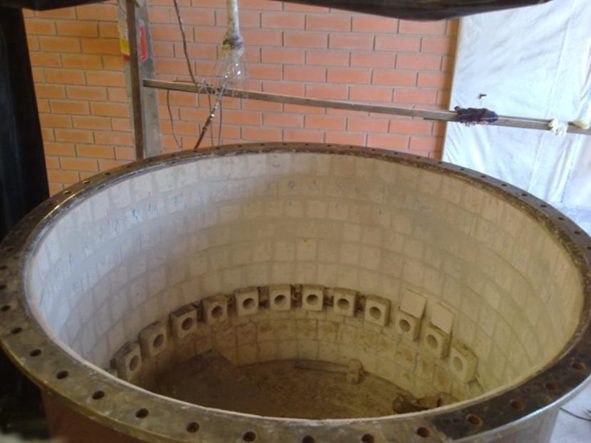
In these sectors, ceramics take the shape of ready-to-install components: cyclones, pipes and elbows, lined pumps, bushings, orifice plates and custom-engineered parts.
How technical ceramics are made
- Raw material — high-purity oxides; CETARCH produces its own alumina, zirconia and rare-earth nanoparticles, contamination-free.
- Forming — pressing, extrusion or slip casting, depending on part geometry.
- Sintering — firing above 1,600 °C in in-house kilns, densifying the material virtually free of glassy phase.
- Grinding & QC — precision machining plus hardness, density and absorption testing to guarantee the specification.
Frequently asked questions about technical ceramics
What is the difference between technical ceramics and advanced ceramics?
None — they are synonyms. "Technical ceramics", "advanced ceramics" and "engineered ceramics" all describe the same family of high-performance ceramic materials, designed for structural and protective functions in industry. On the plant floor, alumina parts are also informally called white ceramic, after the characteristic colour of the material.
Are technical ceramics harder than steel?
Yes, much harder. Technical alumina reaches 9 Mohs and over 1,300 HV Vickers hardness — well above hardened steels and wear alloys such as Ni-Hard. That is why, in pure abrasion, a ceramic component can last 10 times longer than its metal equivalent.
How long does a wear-resistant ceramic lining last?
It depends on the severity of the process, but the field benchmark is up to 10× the service life obtained with Ni-Hard or hardened steel at the same point. Beyond lasting longer, the part keeps its geometry — preserving process efficiency between shutdowns.
Which industries use technical ceramics?
Mining, cement, steel, energy (thermal power), chemical, ceramics and glass, pulp and paper, and agribusiness — any process with abrasion, corrosion or high temperature is a candidate.
Do technical ceramics resist chemicals?
Yes. Alumina is inert to aggressive acids, alkalis and solvents under typical process conditions, with no corrosion and no contamination of the processed material — an important advantage over metals in chemical and pulp & paper plants.
Can ceramic parts be custom made?
Yes. CETARCH designs and manufactures 100% custom parts: engineering analyses the wear point, defines the geometry and the right CT CEDUR formulation, sinters and grinds the part, and follows up installation and field performance.