It depends on the wear regime. Cast basalt, with a typical hardness around 8 Mohs, remains a reasonable choice for moderate sliding abrasion over large areas — chutes, silos and ash pipelines — when budget outweighs service life. Alumina ceramic sits a step above: 9 Mohs and 1,300-1,600 HV in the CT CEDUR line, a level that holds even against hard abrasives such as quartz, at high velocities and at temperatures where basalt drops out. It also allows custom-made parts — elbows, cones and complex shapes — and reaches up to 10× the service life of metal alloys in abrasion. Rule of thumb: moderate wear over a large area, basalt holds its own; in the severe, continuous abrasion regime, CETARCH ceramic is the right choice — it lasts longer and costs less per operating hour.
What cast basalt is — and why it spread across industry
Cast basalt is produced by melting selected basaltic rock and recrystallising the material in moulds, as tiles, plates and pipes. The result is a hard mineral lining — typically around 8 Mohs — and dense (2.9-3.0 g/cm³), with high compressive strength, virtually zero water absorption and good chemical inertness. Against sliding abrasion it comfortably outperforms ordinary steels and cast irons — and it costs little per square metre.
That is why it became the standard for large-area, moderate-abrasion applications: hydraulic ash handling in power stations, chutes, silos, cyclones and heavy-duty industrial floors. If your plant has had basalt installed for decades at one of these points and it lasts through the maintenance cycle, there is no reason to replace it — the material is doing the job it was chosen for.
Where each one wins: the boundary runs through the abrasive
The central rule of tribology is simple: the lining must be harder than the abrasive flowing over it. Ash and coal are relatively soft, and there basalt works comfortably. But quartz — ubiquitous in ore, sand and slag — sits at about 7 Mohs, too close to basalt itself. Alumina ceramic, sintered above 1,600 °C, operates at 9 Mohs and 1,300-1,600 HV: it keeps the hardness margin even against severe abrasives. It is the basis of the wear-resistant ceramic lining applied in mining, cement, power and steel plants.
- Abrasive and velocity — under moderate sliding abrasion, basalt delivers long cycles; with hard particles (quartz, ore) and high velocities, the hardness gap shows quickly and alumina starts lasting several times longer.
- Impact — both are brittle materials, but cast basalt is recommended for low-impact service; alumina has a formulation for abrasion with impact (CT CEDUR 96HH) and works in the hybrid metal casing + ceramic surface.
- Temperature — published references indicate typical basalt operation up to 350-450 °C, with slow heating and sensitivity to sudden variations; alumina, sintered above 1,600 °C, clears that limit with room to spare.
- Geometry — basalt is supplied as standardised tiles and shapes, typically 20-40 mm thick; alumina allows custom-made parts from your drawing — elbows, cones and complex sections with dimensional precision.
Side-by-side comparison
| Criterion | Cast basalt | CT CEDUR alumina |
|---|---|---|
| Hardness | Typically ~8 Mohs | 9 Mohs · 1,300-1,600 HV |
| Density | 2.9-3.0 g/cm³ | 3.7-3.85 g/cm³ |
| Abrasion resistance | High with soft abrasives and moderate velocity | Very high — keeps performing with quartz and high velocities; up to 10× vs. metal alloys |
| Impact | Low — brittle, recommended for impact-free service | Low to medium — 96HH formulation for abrasion + impact; hybrid with metal casing |
| Service temperature | Typically 350-450 °C, with slow heating; sensitive to thermal shock | Far above — material sintered at over 1,600 °C |
| Geometry and precision | Standardised tiles, plates and pipes, typically 20-40 mm | Custom-made parts from your drawing — elbows, cones, complex shapes |
| Relative cost | Lower — the budget option per m² | Higher to buy, lower per operating hour in severe service |
Where basalt is still a reasonable choice
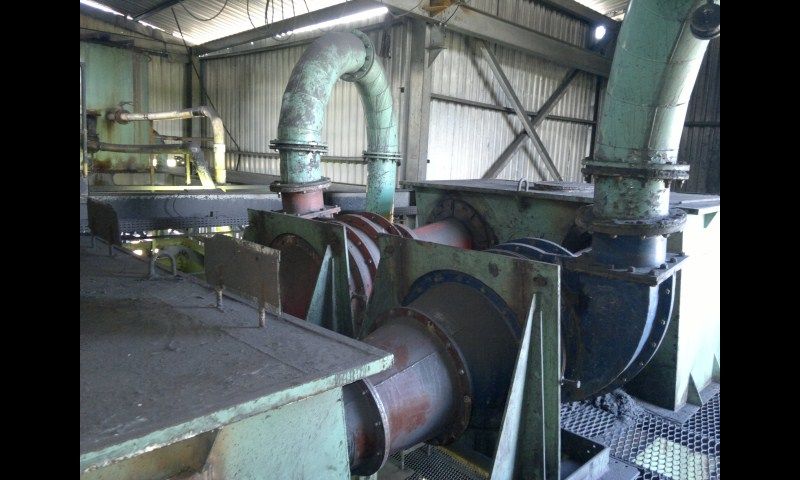
An honest comparison admits it: not every wear point justifies alumina. Large flat areas under moderate sliding abrasion — silo bottoms, ash chutes, floors — are basalt’s natural habitat: the area is large, the abrasive is soft and cost per square metre decides. The game changes at concentrated wear points: elbows and pipes in pneumatic or slurry transport, where velocity is high, the abrasive is hard and every replacement stops the whole line. That is where alumina’s up-to-10× service life flips the equation.
How to decide in practice
- Start with the abrasive — ash, coal and soft materials tolerate basalt; quartz, ore and slag at high velocity call for alumina. The same criterion applies to metal alloys, as the Ni-Hard vs ceramic comparison shows.
- Look at replacement frequency, not part price — the point that goes back on the purchase list at every shutdown is where alumina pays for itself first; that is how it became established in mining.
- Check temperature and geometry — above ~400 °C, under thermal cycling or in complex-shaped parts, basalt drops out of the game; the CT CEDUR 94HH, 96HH and 99HH formulations cover pure abrasion, abrasion with impact and chemical attack, in custom parts manufactured in Criciúma, Brazil.
The verdict: for severe abrasion, alumina ceramic is the superior choice
For severe, continuous abrasion — the regime that defines the service life of most industrial equipment — alumina ceramic is the superior choice. Its hardness is in another class: 9 Mohs and 1,300-1,600 HV, against ~8 Mohs for cast basalt. That translates into up to 10× the service life of metal alloys in abrasion, geometry and precision preserved throughout the cycle, and a formulation matched to the process — CT CEDUR 94HH for pure abrasion, 96HH for abrasion with impact and 99HH for chemical attack. Basalt stays confined to the niche that was always its own: moderate abrasion over large areas, where budget rules.
If your wear point sits in the severe regime, the path is clear: explore the wear-resistant ceramic lining in 100% custom-made parts, manufactured by CETARCH in Criciúma, Brazil, and talk to CETARCH’s engineering team to size the solution for your equipment.
FAQFrequently asked questions: cast basalt vs ceramic
Is cast basalt a bad material?
No. For moderate sliding abrasion, low impact and large areas, it is an established, economical lining — decades of use in ash pipelines, chutes and silos prove it. The limitation appears with hard abrasives such as quartz, high velocities, impact and elevated temperature: in those regimes, alumina’s hardness margin translates into a service life several times longer.
How hard is cast basalt?
Typically around 8 Mohs — above most metals and above quartz (about 7 Mohs), but below technical alumina, which reaches 9 Mohs and 1,300-1,600 HV in the CT CEDUR line. One degree on the Mohs scale sounds small, but the scale is not linear: in severe service it separates a lining that wears from one that barely wears at all.
Can cast basalt handle temperature and thermal shock?
With caveats. Published references indicate typical operation up to 350-450 °C, always with slow heating — the material is sensitive to sudden temperature swings. Alumina, sintered above 1,600 °C, operates far beyond that limit and tolerates process thermal cycles better.
When does alumina justify the extra cost?
When the wear point is concentrated and replacement is recurring: elbows, pipes and parts in contact with hard abrasive at high velocity. With up to 10× the service life of metal alloys in abrasion, fewer stoppages and stable geometry, alumina’s cost per operating hour comes out lower — even though it costs more to buy.