There is no single winner: each material dominates one wear regime. Direct impact from large lumps calls for rubber, which absorbs the energy of the blow instead of trying to resist it. Sliding of fine, wet particles at moderate severity and low temperature is polyurethane’s typical territory. Severe sliding abrasion, high temperature or chemical attack call for alumina ceramic: the CT CEDUR line reaches 9 Mohs and 1,300-1,600 HV, operates up to 1,750 °C and lasts up to 10 times longer than metal at the same wear point. Mixed zones — impact followed by sliding — are the case for hybrid panels, with ceramic tiles embedded in rubber. Below, the full comparison and the practical roadmap — but the bottom line is this: where wear is severe, the right choice is ceramic.
Why this choice is confusing: every vendor is right in one regime
Rubber, polyurethane and ceramic are all legitimate wear liners — and that is exactly why the discussion is confusing: each manufacturer shows the case where its material wins, and all the cases are real. Rubber shines where there is impact; polyurethane, where fines are sliding; ceramic, where abrasion is severe and temperature climbs. Choosing well is not about picking the best brand — it is about identifying the wear regime of your equipment.
The regime is defined by a few variables: the size of the largest lump that falls, the angle of incidence (frontal blow or shallow sliding), the particle size and moisture of the flow, the operating temperature and the chemical aggressiveness. With those mapped, the choice becomes almost automatic — as it does with metal, covered in the Ni-Hard vs ceramic comparison.
Which material wins in each wear regime
The physics of each material explains the outcome. The elastomer absorbs energy by deforming and springing back; polyurethane combines elasticity with high resistance to cutting by fine particles; alumina sintered above 1,600 °C reaches a hardness (9 Mohs, 1,300-1,600 HV) that no polymer or alloy matches — the basis of the wear-resistant ceramic lining. The summary by regime:
- Direct impact from large lumps → rubber — at the drop point of coarse material, the rubber panel deforms, absorbs the energy and springs back; it is also the material that cuts noise the most. In return, it wears fast under severe sliding of fines, and natural compounds typically operate up to about 70 °C (synthetics go past 100 °C).
- Moderate fine, wet sliding → polyurethane — in screening and slurry flow with fine particles, PU typically outlasts rubber and keeps apertures stable. The limits: continuous temperature typically in the 80-90 °C range and a risk of hydrolysis in hot water for polyester-based formulations.
- Severe sliding abrasion, temperature and chemistry → ceramic — where the flow sands the surface hour after hour, alumina barely wears: up to 10× the service life of metal at the same point. And it operates where elastomers cannot even enter: up to 1,750 °C, inert to acids and alkalis.
- Mixed impact + abrasion zones → hybrid panels — ceramic tiles embedded or vulcanized into a rubber matrix: the rubber cushions the blow that would crack the ceramic, and the ceramic withstands the abrasion that would devour the rubber.
Side-by-side comparison
| Criterion | Rubber | Polyurethane | Ceramic (CT CEDUR) |
|---|---|---|---|
| Direct impact from large lumps | Strong point — absorbs the energy | Good in hard compounds; subject to cutting and tearing | Needs design: 96HH or hybrid panel |
| Sliding abrasion (fines) | Moderate — best with soft compounds and slurry | Very good in fine, wet service | Excellent — 9 Mohs, 1,300-1,600 HV |
| Operating temperature | Typically up to ~70 °C (natural); synthetics above 100 °C | Typically 80-90 °C continuous | Up to 1,750 °C |
| Chemical resistance | Depends on the compound | Good — beware hydrolysis (polyester-based) in hot water | Inert to acids, alkalis and solvents |
| Weight | Light | Light | The densest of the three — still lighter than steel |
| Service life in severe abrasion | Short | Intermediate | Benchmark — up to 10× metal |
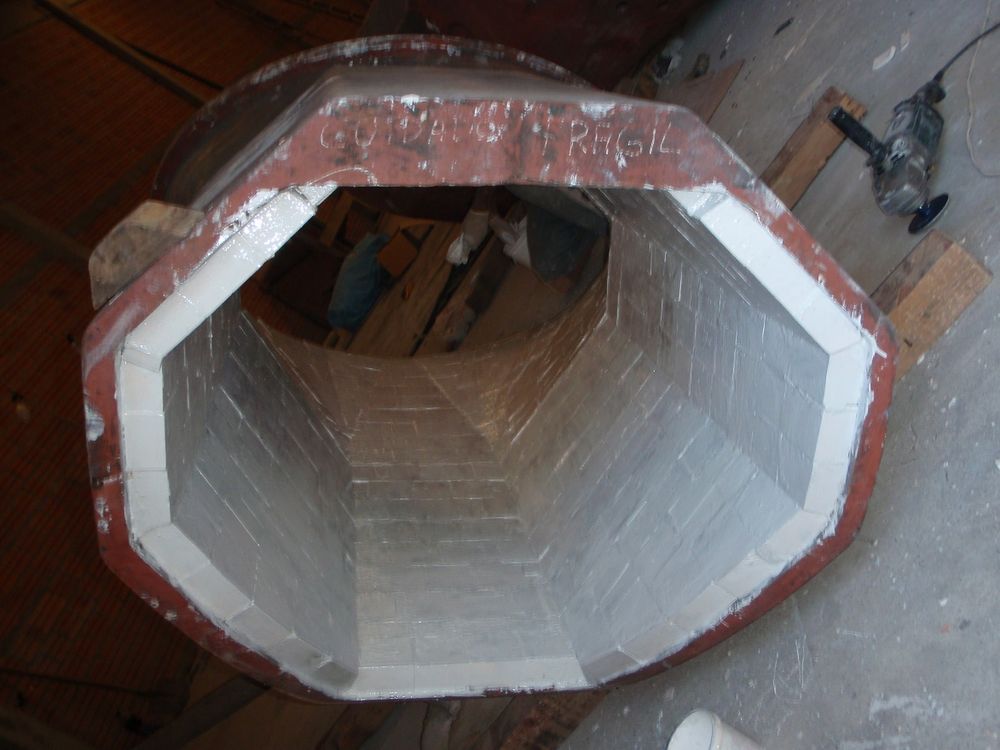
The market standard for mixed zones: the hybrid panel
At real transfer points, impact and sliding coexist — the lump falls, bounces and then slides. That is why the market converged on zoning: rubber or a hybrid panel (ceramic tiles in a rubber matrix) in the impact zone, solid ceramic in the sliding zones. The same logic of combining structure and surface appears in lined slurry pumps and ceramic cyclones: each region of the equipment gets the material its regime demands.
How to decide in practice
- Map the regime — the largest lump that falls and from what height, the angle of incidence, particle size, moisture, temperature and chemistry. These variables — not the catalogue — choose the material.
- Apply the elimination criteria — continuous temperature above ~90 °C typically rules out PU and pushes rubber to its limit; strong chemical attack does the same. If only ceramic remains, the decision is made; below that, compare service life by regime.
- Zone it, and start at the part you replace most — pure impact, rubber; mixed, hybrid panel; severe sliding, ceramic. Ceramic parts are custom-made in Criciúma/SC, Brazil, from your drawing or a reference part — the up-to-10× gain shows first at the point that consumes the most maintenance today.
The verdict: where wear is severe, the answer is ceramic
Let’s be direct: rubber and polyurethane have legitimate niches — heavy direct impact for the former, low-severity fine sliding for the latter. But where wear actually consumes budget — severe sliding abrasion, high temperature, chemical attack — alumina ceramic is the definitive choice: 9 Mohs and 1,300-1,600 HV, a hardness no polymer reaches, service up to 1,750 °C and up to 10× the service life of metal at the same point. And even in mixed impact-plus-abrasion zones, the answer is still ceramic: the 96HH formulation, developed for abrasion with impact, or hybrid panels with embedded ceramic tiles.
If your equipment sits in the severe regime, the next step is sizing the solution: see the ceramic wear plates, custom-made in Criciúma/SC, Brazil, or request a quote from your drawing or a reference part.
FAQFrequently asked questions: rubber, PU or ceramic
Transfer chute: rubber or ceramic?
Zone it. At the drop point of coarse material, rubber or a hybrid panel absorbs the impact; on the walls and bottom, where the flow slides, alumina ceramic lasts far longer. A whole chute in a single material almost always wastes money in one of the zones.
Can polyurethane handle hot slurry?
With caveats. The typical continuous temperature limit of PU sits in the 80-90 °C range, and in hot water polyester-based formulations suffer hydrolysis — an irreversible loss of mechanical properties. Polyether-based formulations resist moisture better, but for higher temperatures the path is ceramic, which operates up to 1,750 °C.
Does ceramic crack under impact?
Under direct impact from large lumps, conventional ceramic can crack — which is why there are two answers: the CT CEDUR 96HH formulation, developed for abrasion with impact, and hybrid panels, where the rubber cushions the blow and the ceramic tile withstands the abrasion.
Can I combine materials in the same equipment?
Yes — it is the dominant practice. Zoning puts each material in the regime where it wins: rubber at the impact, ceramic at the sliding, hybrid at the transition. Since ceramic parts are custom-made, the lining follows the real geometry of the equipment, zone by zone.